LAWMAKERS VET FIREARM CONTROL MEASURE, APPROVE ADDITIONAL MEASURES IN LEGISLATIVE SESSION
Published: Jun 12, 2026
ST. THOMAS, VI — The 36th Legislature of the Virgin Islands, led by Senate President Milton E. Potter convened into Committee of the Whole and Legislative Session at the Earle B. Ottley Legislative Hall. Lawmakers received testimony on a measure that would define and prohibit assault rifles, ban suppressors and silencers, require safety training for licensed rifles and shotgun holders; prohibit large capacity magazines and prevent the illegal sales of firearms, firearm accessories and ammunition. Approved items on today’s agenda will be sent to the Governor for further consideration and action.
Lawmakers first met in Committee of the Whole to receive testimony on Bill No. 36-0144, An act amending title 14 Virgin Islands Code, chapter 113 to define and prohibit assault rifles, ban suppressors and silencers, require safety training for licensed rifles and shotgun holders; prohibit large-capacity magazines and prevent the illegal sales of firearms, firearm accessories and ammunition. The measure was sponsored by Senators Clifford A. Joseph Sr. and Marise C. James.
Adam Christian, a licensed attorney in the US Virgin Islands states that the proposed legislation does not adequately reflect the core of Bruen, that individuals have a presumptive constitutional right to carry firearms for self defense in public. Christan states that the proposed measure focuses heavily on expanding regulation while giving insufficient weight to that protected right. Christian’s testimony voiced numerous constitutional concerns, including the ban on magazines over 15 rounds, which he said did not take into consideration firearms that are manufactured with those magazines, an exemption for retired law enforcement officers, which creates an equal protection problem, and the repeal of the education fund initiative, which would place licensing fees into the general fund, which Christian states is unconstitutional, because he states such fees should only be used to administer that right. Christian states that the bill places too much subjective power in the hands of the Police Commissioner. Furthermore, he states that the effective date of the proposed measure is unrealistic, stating that VIPD cannot promulgate regulations, obtain gubernatorial review, secure legislative review, as well as train peace officers in 60 days. Christian recommended that the measure be amended to address all concerns.
Kosei Ohno, founder of Virgin Islands Safe Gun Owners spoke in opposition of the proposed measure. Ohno stated that the US Department of Justice has already sued the Virgin Islands Police Department for unconstitutional firearms practices, making it dangerous for the Legislature to pass another bill that would deepen federal scrutiny. Ohno stated that an amended measure, while less extreme than the original bill, is still unconstitutional and is still incredibly over discretionary and burdensome for ordinary citizens. Ohno states that the measure includes issues such as expansive sensitive place restrictions, high costs, lack of due process protections, and criminal penalties that could trap law abiding people. Additionally, Ohno states that legal gun owners are not the source of crime and burdensome regulations do not stop criminals.
Ohno stated that real public safety comes from targeting violent offenders, improving community conditions and supporting responsible citizens. Ohno offers VISGO Amendment A35 as an alternative that includes clear standards, lower fees, independent oversight, and protections against arbitrary government action. Ohno urged the body to hold the measures and hold proper hearing and develop a framework that respects rights and enhances safety.
Sean Santos, Assistant Commissioner of the Virgin Islands Police Department voiced support for the proposed measure. Santos said that it strikes an effective balance between public safety and the rights of law-abiding gun owners. He stated that the amended provide clearer definitions, especially regarding restricted firearms, and removes subjective licensing criteria such as “good character” or “need”, ensuring a fair, objective and transparent permitting process. Santos states that the 90-day compliance window for individuals who already have newly restricted firearms shows respect for existing owners while guiding future lawful use. Santos states that the measure, as amended offers clarity for citizens and law enforcement alike, which reduces confusion and prevents unintentional violations.
Additionally, Santos’ testimony supports targeted safety measure such as prohibiting large capacity magazines, which he argues are associated with criminal misuse and pose heightened risk to officers and the public. He endorsed the measure’s call for mandatory safety training for rifle and shotgun owners, calling it one of the most beneficial components because it promotes responsible handling, storage, and marksmanship. Furthermore, Santos said that the Virgin Islands Police Department is prepared to make training accessible, such as making Department ranges open to the public. He stated that the measure was a balanced and comprehensive approach.
Gordon Rhea, Attorney General of the US Virgin Islands spoke in support of the proposed measure. According to Rhea, he stated that the proposed amended measure strikes a necessary balance between protecting constitutional gun rights and ensuring public safety. Rhea stated that recent Supreme Court rulings require the US Virgin Islands to update its firearms laws, because current statutes contain “proper cause” requirements that federal courts have already deemed unconstitutional. He stated that if the existing framework is struck down in ongoing litigation before the Legislature act, the territory could lose essential licensing and enforcement authority, creating a dangerous regulatory vacuum. Rhea stated that the act would avoid that outcome by replacing subjective standards with objective shall issue licensing rules, lowering fees, setting firm deadlines, protecting privacy, and ensuring that law aiding citizens can carry concealed firearms for self-defense. Rhea further emphasizes that the act preserves strong public safety measure that courts have consistently upheld. Rhea urged the body to adopt the measure.
Mary Moorhead, a licensed gun owner in the territory, supported the measure. Moorhead stated that he believed that responsible gun ownership and reasonable regulation can coexist. Stating that owning a gun is a serious responsibility and that the bill does not threaten the rights of law-abiding citizens. She states that stronger standards, especially safety training help prevent accidents caused by negligence or lack of knowledge. She stated that proper handling and storage protect gun owners, families, children, and the wider community. Moorehead also highlights the territory’s struggle with gun violence and that the community should not accept shootings as normal. She described the measure as a practical step towards improving gun safety while preserving constitutional rights.
Ehren Henderson, a licensed gun owner in the territory opposed the measure. Henderson’s testimony stated that the newly amended measure places burdens on law abiding, licensed firearm owners, rather than the traffickers and violent offenders driving gun crime in the territory. Henderson stated that most official data shows that most recovered crime guns originate from out of territory trafficking, not from local licensees but the measure expands criminal exposure for compliant citizens through broad sensitive place rules, strict long gun transport requirements, ongoing reporting mandates, and penalties tied to magazine capacity. Henderson warned that the definitions in the bill could criminalize ordinary conduct, such as picking up a child from school or arriving at a hospital during an emergency. Additionally, Henderson also argued that the long-gun box requirement is impractical for everyday use and it leaves citizens uncertain about what is legal. He states that many provisions of the proposed measure are very vague, unworkable, or counterproductive. He urged the Legislature to reject the measure or substantially revise it.
Luis Valdes, the Southeast Regional Director for Gun Owners of America states that the proposed measure is unconstitutional. Valdes stated that although the measure claims to be a “shall issue” framework, it is functioning as a restrictive prior restraint system. He states that the bills combinations of mandatory firearm registration, a total ban on open carry, near total restrictions on long gun carry and an expensive lit of sensitive places prevent ordinary citizens to exercise their right to armed self-defense. Furthermore, Valdes states that the bans on standard capacity magazines, silencers, and accessories lack historical jurisdiction and fail the constitutional test established by the Supreme Court. Valdes also states that the legislation disproportionally hurts minority and working-class communities by imposing high fees, training mandates, registration requirements, and criminal penalties for storage and technical violations. He states that these burdens will fall hardest on those who most need the means of self-defense, while doing little to deter violent criminals. Valez urged the body to reject the measure.
Kostas Moros, the Director of Legal Research and Education at the Second Amendment Foundation urged the body to delay action on the measure as amended. Many major court decisions, many addressing issues in the measure are imminent in the U.S. Supreme Court and The Third Circuit, whose rulings are binding on the US Virgin Islands. Moros’ testimony states that many provisions in the measure such as private property carry rules, restrictions on young adults, marijuana related disarmament, sensitive places bans, magazine limits and “assaults weapon” prohibitions are currently being reviewed. Moros also warned of the practical and financial risks of passing legislation that will almost immediately trigger litigation and could expose taxpayers to unnecessary legal costs. Moros urges the body to wait for the rulings from the Supreme Court and the Third Circuit of Appeals to determine the legality of many elements in the amended measure.
Lawmakers then returned to Legislative Session. Lawmakers voted to override the Governor’s veto of Section 9 of Act 9100. Lawmakers then approved the following measures:
- Bill No. 36-0144, An act amending title 14 Virgin Islands Code, chapter 113 to define and prohibit assault rifles, ban suppressors and silencers, require safety training for licensed rifles and shotgun holders; prohibit large-capacity magazines and prevent the illegal sales of firearms, firearm accessories and ammunition. The measure was sponsored by Senators Clifford A. Joseph Sr. and Marise C. James.
- Bill No. 36-0310, An act amending Act No. 8870 and 8985 regarding the $1,000,000 appropriated in Act. No. 8870 for the Ivanna Eudora Kean High School track and field facilities. The measure was proposed by Senator Kurt A. Vialet.
- Bill No. 36-0312, An act amending Act No. 9022 regarding compensation for unused leave for legislative employees upon separation. The measure was proposed by Senator Kurt A. Vialet.
- Bill No. 36-0309, An act appropriating the sum of $387,784 from the Virgin Islands Education Initiative Fund to the Department of Education to conduct extended school year evaluations to determine students’ eligibility for special education services. The measure was proposed by Senator Kurt A. Vialet.
Senators present at today’s Legislative Session included Milton E. Potter, Kenneth L. Gittens, Marvin A. Blyden, Angel L. Bolques, Jr., Dwayne M. DeGraff, Ray Fonseca, Novelle E. Francis, Jr., Alma Francis Heyliger, Hubert L. Frederick, Franklin D. Johnson, Carla J. Joseph, Avery L. Lewis, and Kurt A. Vialet.
The Division of Public Affairs is committed to providing the community with accurate information on legislative proceedings and other events at the Legislature of the Virgin Islands. Visit legvi.org.
####
Related Content
COMMITTEE RECEIVES TESTIMONY REGARDING THE TERRITORY’S ECONOMIC AND WORKFORCE CONDITIONS
October 13, 2026
ST. CROIX, VI – The Committee on Economic Development and Agriculture, led by Senator Hubert L. Frederick met in the Fritz E. Lawaetz Legislative Conference Room. Lawmakers received testimony from the Virgin Islands Department of Labor, Bureau of Economic Research, and Economic Development Authority regarding the territory's current workforce...

COMMITTEE HOSTS YOUTH MENTAL HEALTH, SCHOOL ATTENDANCE, AND TRUANCY TOWN HALL
October 2, 2026
ST. THOMAS, U.S. VIRGIN ISLANDS — The Committee on Culture, Youth, Aging, Sports, and Parks, chaired by Senator At-Large Angel L. Bolques Jr., convened a town hall at the University of the Virgin Islands 13D Research and Strategy Innovation Center on...
LAWMAKERS EXAMINE HOUSING AND TRANSPORTATION CHALLENGES ACROSS THE TERRITORY
September 30, 2026
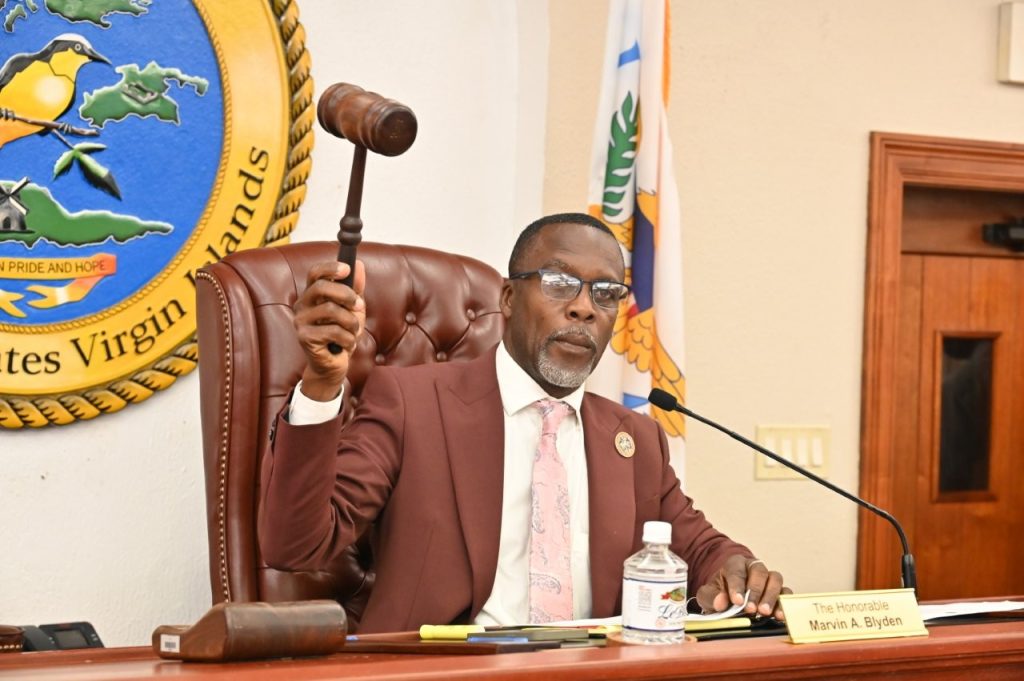
ST. THOMAS, U.S. VIRGIN ISLANDS — The Committee on Housing, Transportation and Telecommunications, chaired by Senator Marvin A. Blyden, convened at the Earle B. Ottley Legislative Hall to examine critical housing and transportation issues affecting residents across the Territory. The Committee...