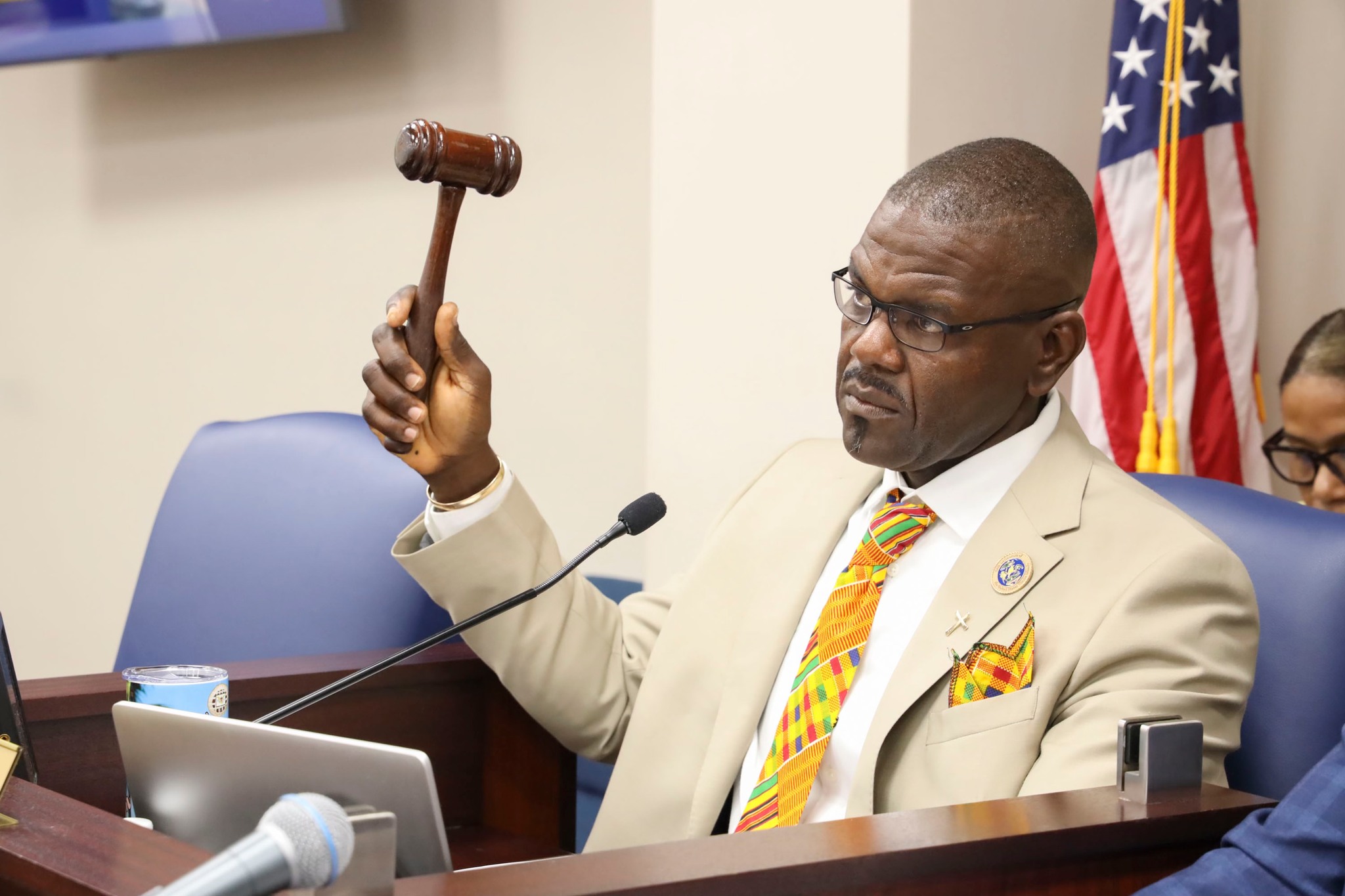
ST. CROIX, VI – The 36th Legislature of the Virgin Islands’ Committee on Homeland Security, Justice, and Public Safety, led by Senator Clifford A. Joseph, Sr, met in the Frits E. Lawaetz Legislative Conference Room. Lawmakers received updates from the Virgin Islands Fire and Emergency Medical Services and the Virgin Islands Police Department concerning its operations.
Antonio Stevens, Director of the Virgin Islands Fire and Emergency Medical Services updated the body on its operations. VIFEMS currently employees 291 personnel, which are organized into units or divisions. These include the Suppression Unit, the EMS Unit, the Prevention Unit, and the Administrative Unit. Stevens stated that staffing has remained an issue for the department, stating that the Suppression and the EMS units have the most critical staffing needs. Stevens stated that recent firefighter and EMT recruit classes have helped to address the issue, but the number of new hires has not been enough to eliminate staffing gaps in the suppression unit.
Stevens stated that recruitment and retention of fire personnel have not been a concern. However, separations due to retirements have reduced staffing gains. Since the integration of the Fire and Emergency Medical Services, there has been a significant increase in the number of EMS providers the agency employees. The number of EMS personnel has grown. However, there is still a major need for paramedics. Stevens voiced desire to increase paramedic staffing through training. Staffing challenges have increased the need overtime. However, Stevens voiced optimism that overtime would be reduced with the addition of the next recruit class.
The Department has focused on expanding and upgrading its emergency fleet. Marine 1, a state-of-the-art firefighting vessel entered service in 2025. In early 2026, seven new ambulances were commissioned. Three ambulances were assigned to St. Croix, three to St. Thomas, and one to St. John. Some older ambulances will be removed from the fleet, but some will remain in the fleet. Facility improvement is underway, most of which will be funded through disaster recovery grants. These projects include repairs that have been completed at the George Scott Maintenance Building, the Emile Berry Fire Station, and the Omar Brown Fire Station. Recovery projects for the Herbert L. Canegata Fire Station and Emile Henderson Fire Station are currently in progress. Additionally, projects for the replacement of the Renceliar I. Gibbs, Robert O. Connor, George Scott and Fortuna Fire Stations are underway, which are all part of the Territorial Fire Bundle. Work on the Charles A. Seales Fire Station is not included in the bundle has been suspended pending determination from FEMA.
The following bills were held in Committee at the call of the Chair, due to the unavailability of necessary amendments:
- Bill No. 36-0139, An act amending Title 31 Virgin Islands Code to assess civil liability for destruction or damage to government property through willful or negligent act. The measure was sponsored by Senator Avery L. Lewis.
- Bill No. 36-0144, An act amending Title 14 Virgin Islands Code, chapter 113 to define and prohibit assault rifles, ban suppressors and silencers, and requiring safety training for licensed rifles and shotgun holders, prohibiting large-capacity magazines and preventing the illegal sales of firearms, firearm accessories and ammunition. The measure was sponsored by Senator Clifford A. Joseph, Sr.
- Bill No. 36-0151, An act amending Title 23 Virgin Islands Code regarding the illegal possession of machine guns and machine gun conversion devices. The measure was sponsored by Senator Angel L. Bolques, Jr.
Sean Santos, Assistant Commissioner of the Virgin Islands Police Department also delivered an update of the Department’s operations. Testimony stated that the department continues to advance its comprehensive public safety framework for operational enhancement, saying it remains on schedule with several major initiatives designed to strengthen investigative capacity, interagency coordination and community protection throughout the territory. The Department has completed Phase two of its territory wide public safety camera expansion initiative. This has expanded fixed surveillance coverage at strategic corridors, commercial zones, and crime hotspots. The Flock License Plate Reader (LPR) pilot program is now installed and operational, which enhances the ability to identify stolen vehicles, and vehicles linked to violent crimes, support amber and silver alert, provide time stamped investigative leads, and strengthen intelligence driven policing strategies.
Santos noted that the physical infrastructure buildout of the Real Time Crime Center has reached a significant milestone, with Phase 1 completed, which includes hardware installation. Core hardware deployment has been finalized in partnership with ROC Solutions. System integration framework has been completed with Fusus. Network architecture and monitoring stations have been installed, as well as data intake servers and analytic processing units have been activated. Both Districts in the territory now have the hardware needed to support centralized, data driven policing operations.
The Department is now executing Phase 2 of the Software Integration and System Synchronization, which focuses on comprehensive software deployment and cross platform synchronization of all data collection systems. These integrated systems include in care camera and reporting solutions, Vehicle GPS tracking platforms, mobile routing systems for real time vehicular connectivity, territory wide CCTV feeds, LPR data integration, and future body worn camera interoperability. This phase will also include the launch of the “Drone as a First Responder” program, which will provide rapid aerial situational awareness, enhance officer safety during high-risk responses, reduce response times to priority calls, and improve search operations and perimeter containment. The program will operate in coordination with VIFEMS to support fire suppression, emergency medical response, disaster management and large-scale incidents.
The Department is currently in the procurement and evaluation phase for upgrading both its body worn camera systems and electronic control devices. The upgrades are expected to improve video clarity and evidentiary reliability, enhance officer accountability and transparency, increase device functionality and safety features, and ensure compliance with evolving evidentiary standards. Additionally, the Department is finalizing the scope of work for the Traffic Light Enforcement Program. It will address red light violations, improve roadway safety, reduce intersection related collisions, and provide enforcement related capabilities. The initiative is the final component of the Commissioner’s triarchy of technological upgrades, which include territory wide surveillance and LPR expansion, real time crime centers and integrated intelligence systems, and automated traffic enforcement implementation. The Real Time Crime Centers are expected to be operation before July 2026. Santos also voiced confidence that the Police Department would soon be able to be removed from the consent decree.
Senators present at today’s Committee meeting included Clifford A. Joseph, Sr., Ray Fonseca, Angel L. Bolques, Jr., Novelle E. Francis, Jr., Kenneth L. Gittens, Avery L. Lewis, and Kurt A. Vialet.
The Division of Public Affairs is committed to providing the community with accurate information on legislative proceedings and other events at the Legislature of the Virgin Islands. Visit legvi.org.
####