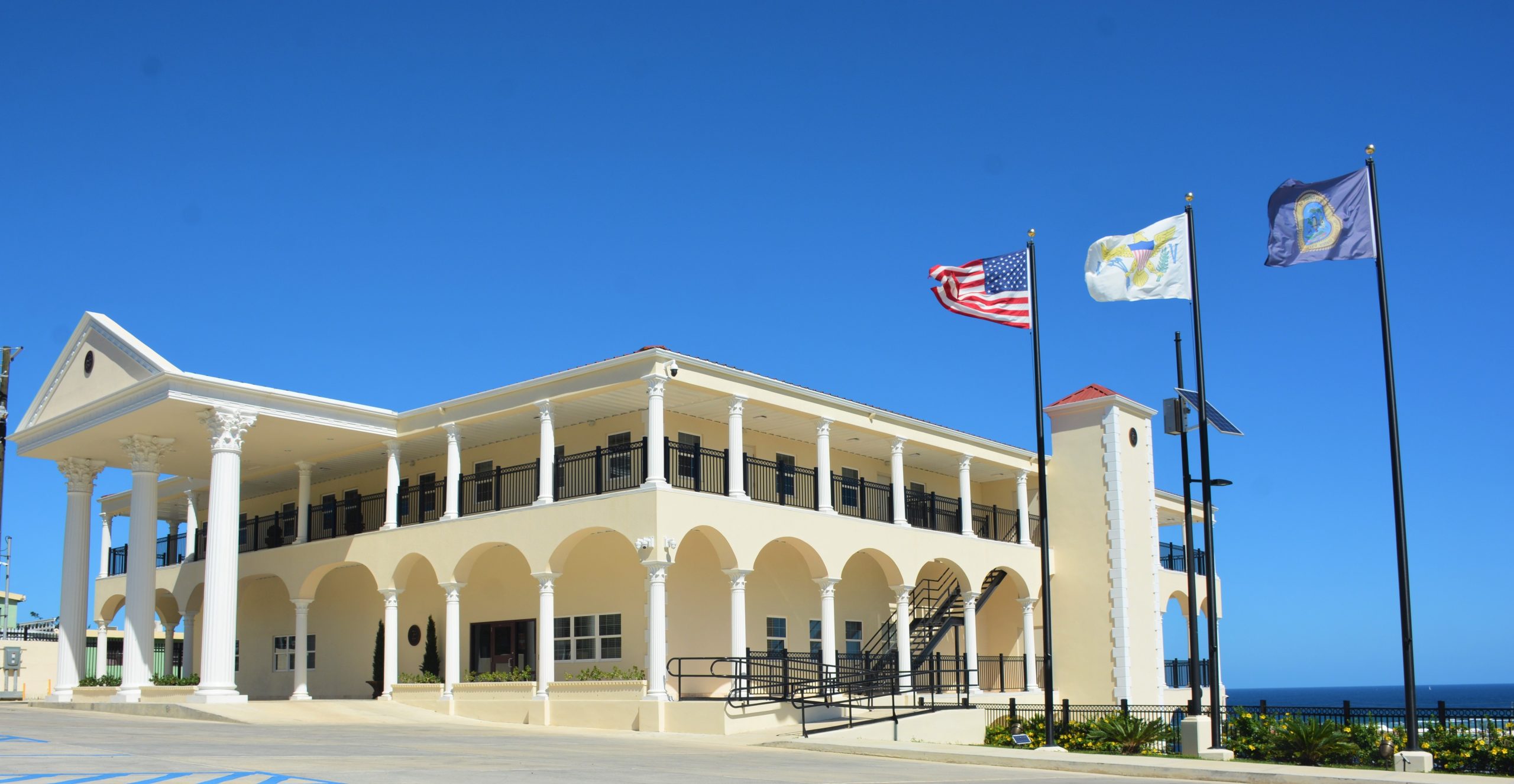
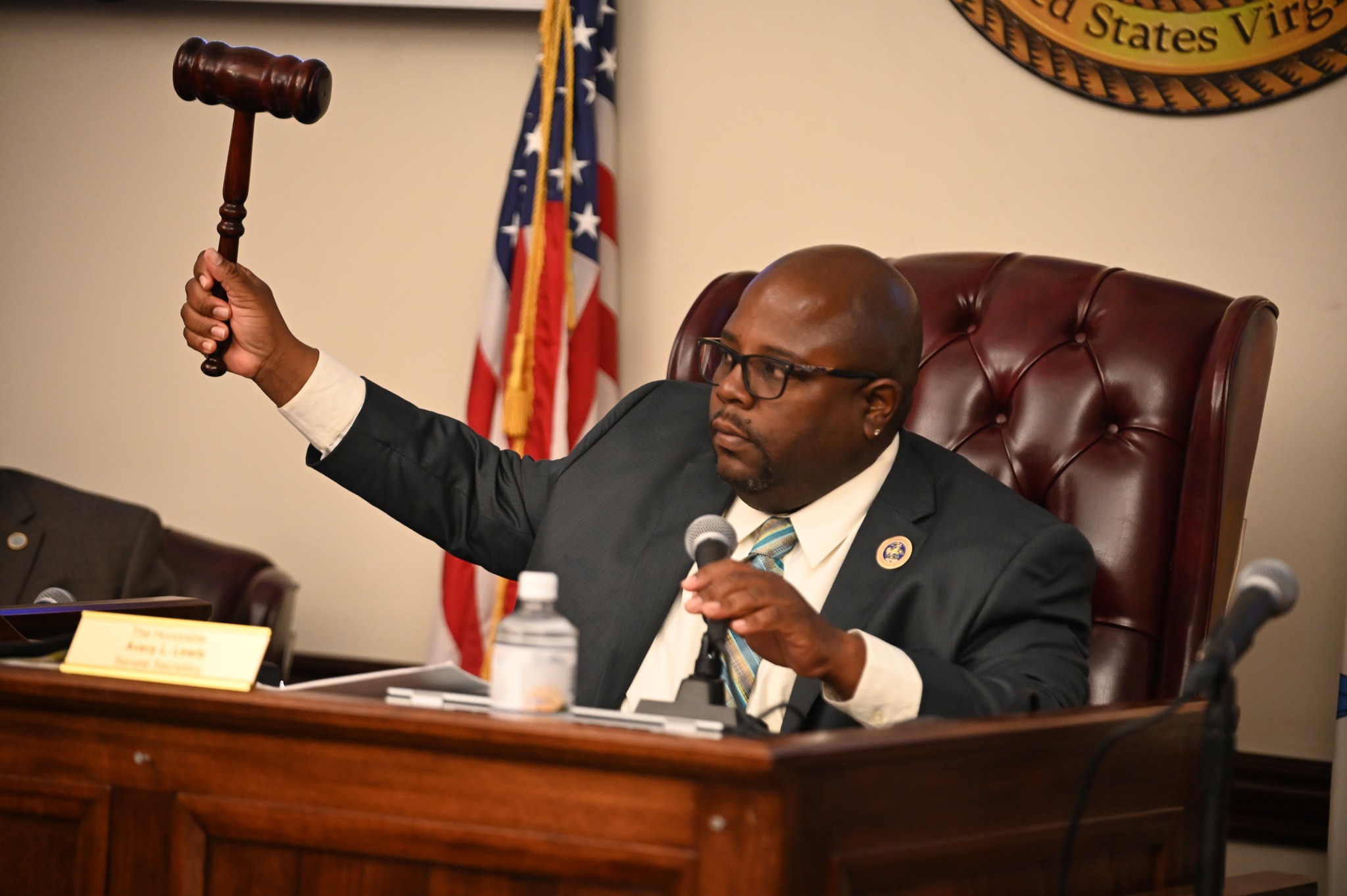
ST. THOMAS, VI– The Committee on Government Operations, Veterans Affairs, and Consumer Protection, chaired by Senator Avery L. Lewis, met at the Cleone H. Creque Legislative Conference Room. Lawmakers received testimony to discuss several measures and receive updates regarding the territory’s emergency services and waste management strategies. All items approved during the meeting will be forwarded to the Committee on Rules and Judiciary for further consideration.
The committee first received testimony from Mr. Antonio Stevens, Director of the Virgin Islands Fire and Emergency Medical Services. Director Stevens expressed the agency’s support for Bill No. 36-0232, an act amending Act No. 8018 to authorize the disposal of green waste using controlled incineration technologies, including air curtain incinerators. According to his testimony, the accumulation of green waste at local landfills creates significant fire hazards if not managed. Stevens noted that landfill fires require considerable resources and several days to extinguish.
Director Stevens stated that the proposed measure provides the Virgin Islands Waste Management Authority with the legal framework necessary to implement a safer waste management strategy. While VIFEMS supports the bill as written, Stevens recommended a few specific revisions regarding the permitting of open burning on private property.
Lawmakers then heard from Daryl Griffith, Chief Financial Officer of the Virgin Islands Waste Management Authority. Griffith provided testimony on the Authority’s plan to utilize Air Curtain Incinerators as a primary method for managing the territory’s green and wood waste. He explained that the USVI generates between 80 and 85 tons of green waste daily, totaling approximately 31,000 tons per year. Griffith noted that the Bovoni Landfill on St. Thomas currently cannot accept this material due to a lack of space, which has led to increased instances of illegal dumping and stockpiling.
According to the testimony, Air Curtain Incinerators are engineered combustion systems that use curtain of air to trap smoke and particles. Griffith clarified that this technology is formally recognized by the EPA and FEMA and is not the same as an open burn pile. The system is designed to operate at 10% opacity or less, meaning the air remains clear during most of the burning process. The Authority highlighted that adopting this technology would reduce vegetative material by up to 90%, significantly extending the lifespan of the territory’s landfills.
The committee also received testimony from Daryl D. Jaschen, Director of the Virgin Islands Territorial Emergency Management Agency. He noted that the territory remains under a federal mandate to keep all vegetation debris within the U.S. Virgin Islands. He reminded lawmakers that Hurricanes Irma and Maria generated about 850,000 cubic yards of debris, with vegetation accounting for over 60% of that total. The current ban on burning vegetation debris under Act 8018 has limited the territory to only two reduction options: composting and mulching. Jaschen stated that while these methods are feasible, they are slow and require significant land area, which is a scarce resource. He noted that there are currently no permanent locations for vegetation debris on St. John or Water Island, making a rapid reduction method like incineration essential for clearing public spaces. Jaschen emphasized that the EPA recently updated its regulations to remove certain permit requirements for ACIs during declared states of emergency, if they only burn clean wood and yard waste.
After discussion, Bill No. 36-0232 was held in Committee at the call of the Chair.
Lawmakers also reviewed Bill No. 36-0233, an act amending title 32 of the Virgin Islands Code to clarify the establishment and operation of the Virgin Islands Lottery. The committee received testimony from Raymond J. Williams, Executive Director of the Virgin Islands Lottery, who spoke in support of the measure. Williams stated that the 90-year-old agency is the second oldest lottery in the United States and operates as a unique government entity that generates its own revenue without any financial appropriations from the central government.
According to the testimony, the Lottery currently returns nearly 80% of its revenue to the community through mandated transfers. These funds support various public needs, including pharmaceutical purchases for the indigent through the Department of Human Services and the Department of Education’s Initiative Fund. Additionally, the agency provides funding for GERS retiree annuities, the territory’s horse racing commissions, and the Office of Veterans Affairs. Williams emphasized that an autonomous model is essential for the enterprise speed required in the gaming industry, aligning the territory with approximately 31 other independent lotteries across the U.S. and Canada.
The push for legislative clarity follows a 2022 Attorney General’s opinion which concluded that the Lottery must utilize the central government’s Department of Property and Procurement for its operational needs. Williams argued that this requirement creates an “almost impossible” hurdle for an entity that must operate expeditiously to remain competitive. He noted that unlike other autonomous agencies such as WAPA or the Port Authority, the Lottery receives no federal funding and relies entirely on its own commercial performance. The proposed measure would grant the agency express authority to manage its own procurement and remove the Governor’s absolute veto over commission decisions while maintaining regular reporting requirements.
Bill No. 36-0233 was held in committee for further vetting after discussion.
Senators present at today’s Committee hearing were Avery L. Lewis, Novelle E. Francis, Ray Fonseca, Alma Francis-Heyliger, Kenneth L. Gittens, Carla J. Joseph, and Clifford Joseph.
The Division of Public Affairs is committed to providing the community with accurate information on legislative proceedings and other events at the Legislature of the Virgin Islands.
Visit legvi.org.
####